

PyLumerical 0.5.dev0#
Useful links: Installation | Source Repository | Issues
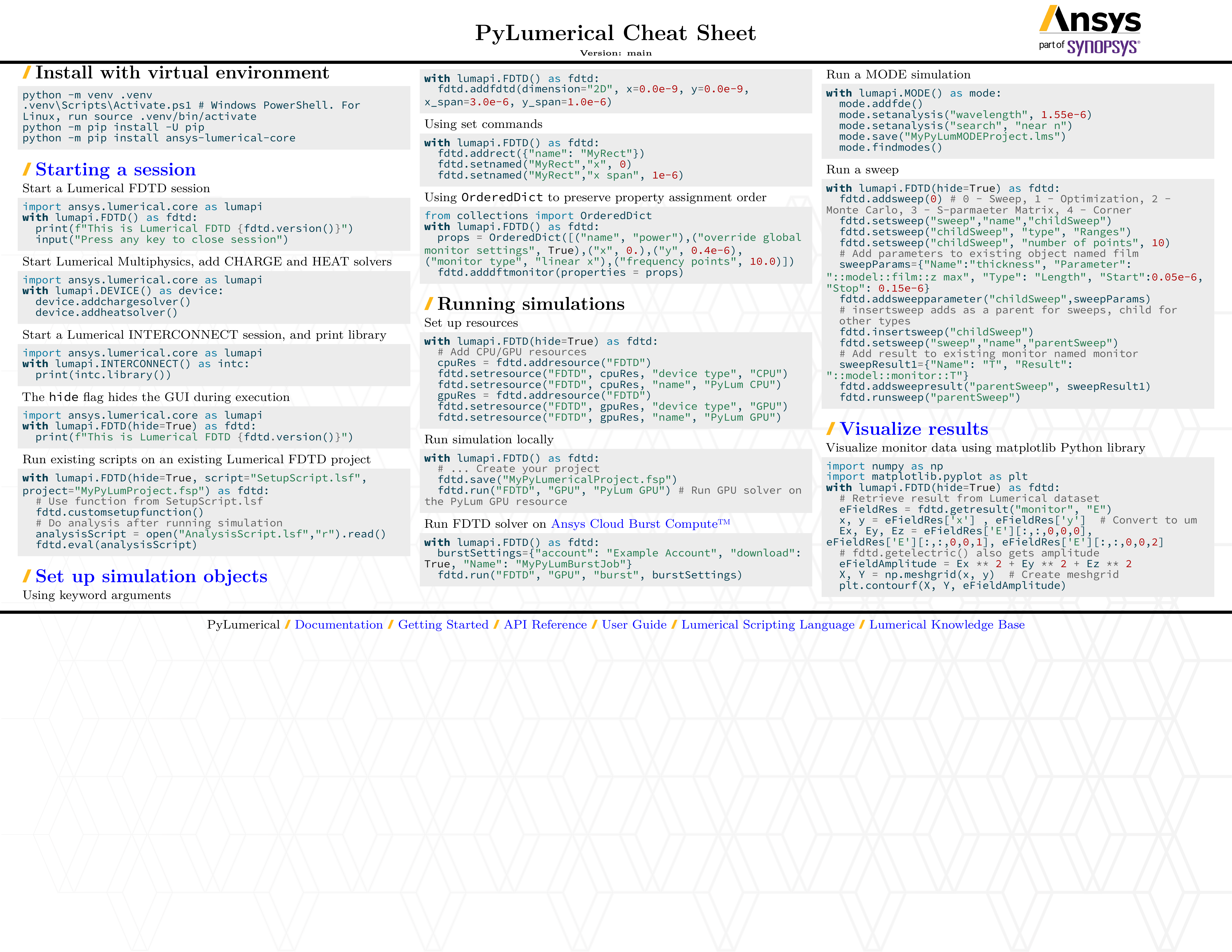
PyLumerical is the Python automation library for Ansys Lumerical photonics simulation software. Use PyLumerical to seamlessly control Ansys Lumerical products including Ansys Lumerical FDTD™, Ansys Lumerical MODE™, Ansys Lumerical Multiphysics™, and Ansys Lumerical INTERCONNECT™ directly in Python.
Capabilities#
Set up geometry, material, run simulations locally and on cloud, and retrieve results from Lumerical products.
Quickly set up and run photonic inverse design using lumopt2.
Leverage Lumerical Scripting Language commands with Pythonic syntaxes, seamlessly integrate with existing automation scripts.
Leverage extensive Python libraries and easily integrate with other Ansys products through the PyAnsys ecosystem to create powerful multiphysics workflows.
Note
The Lumerical inverse design modules lumopt and lumopt2, as well as the high performance computing (HPC) scheduler automation library lumslurm, are distributed with Lumerical products and are not included in the ansys-lumerical-core wheel.
The Lumerical Python API is still provided with Lumerical products.
Documentation#
Getting started
New to PyLumerical? This quick start guide provides you with information to rapidly get started.
User guide
In-depth information on key concepts of PyLumerical.
API reference
Description of classes and methods of PyLumerical.
Examples
Application examples with PyLumerical.
Contributing
Learn how to contribute to the PyLumerical project.